 Cartagena City Guide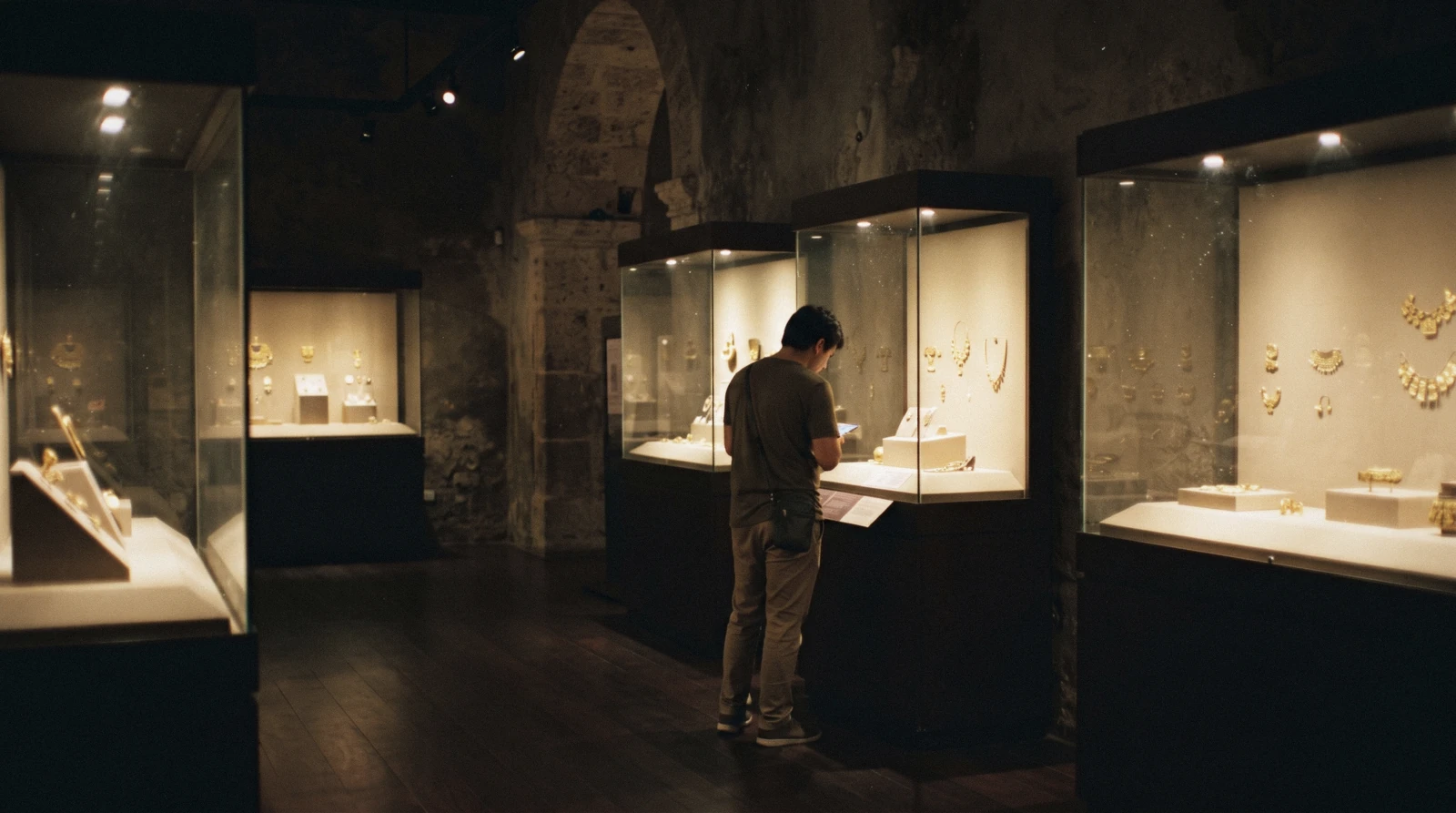
Museo del Oro Zenú, Cartagena
Museo del Oro Zenú Cartagena is the free museum on Plaza de Bolívar run by the Banco de la República, and it is worth its own stop even though nothing about entry costs a peso: the pre-Columbian Zenú culture's goldwork and the drained-field hydraulic system that supported it are two of the more genuinely surprising things you'll see in Cartagena's Walled City. This guide has the hours straight from Banco de la República's own museum network, what the goldwork technique actually was, and how a free visit compares to paying for a guided historic-center walk. The Cartagena city guide covers the rest of the plaza's sights the same way.
Quick answer Free entry, hours, and what the goldwork and hydraulics displays actually show
Museo del Oro Zenú is free to enter for everyone, part of the Banco de la República's gold museum network that operates the same way across Colombia. It's open Tuesday to Saturday 9:00 a.m. to 5:00 p.m. and Sunday 10:00 a.m. to 3:00 p.m., and closed Monday, which is the single most common mistake since a free museum has no reservation fallback if you land on a Monday.
Key takeaways
- The museum holds Zenú semi-filigree goldwork, cast by the lost-wax method, covered in what's inside below.
- The Zenú also built a drained-field hydraulic system covering roughly 500,000 hectares, the museum's other main subject.
- It sits on Plaza de Bolívar next to the paid Palacio de la Inquisición, an easy pair for one stop.
Key facts
Opening hours
| Tuesday-Saturday | 9:00–17:00 |
|---|---|
| Sunday | 10:00–15:00 |
Closed Monday
Admission
- Adult
- Free for everyone
- Reduced
- Free for everyone
- Free
- All visitors, part of the Banco de la República's nationwide gold museum network
Planning it
- Time needed
- Not stated officially. Our routing: 30 to 45 minutes for the galleries
- Book ahead
- Optional — walk-up usually fine
- Address
- Plaza de Bolívar, Cartagena de Indias
Museo del Oro Zenú charges nothing at the door. The table below sets that against the one guided option that covers the same plaza, so you can see what paying would actually add.
There's no price tier to choose between, entry is free, so the actual decision is whether to walk in on your own or add a paid guided walk of the surrounding plaza for context before or after your free visit.
| Option | Price | Includes | Cancel | Book |
|---|---|---|---|---|
| Self-guided entryAnyone visiting Plaza de Bolívar, no booking or payment required | Free | Full museum galleries, no ticket or reservation needed | Not applicable | Official site |
| Historic-center guided walk (passes Plaza de Bolívar)Visitors who want a guide's context on the square before stepping into the free museum on their own | From $14.81 | A guide's context on the plaza and surrounding streets. The museum's own galleries are not itemized on this or any GetYourGuide listing | Free up to 24 hours before | Check Availability |
No GetYourGuide or Viator listing bundles entry to Museo del Oro Zenú specifically, since there's no ticket to bundle. Figures current in Q3 2026.
Pair the free museum with a Walled City walk
This walking tour covers the historic center generally and is not confirmed to stop specifically at the museum, use it for context before or after your own free visit. Prices in USD as listed by GetYourGuide.
 from $14.81
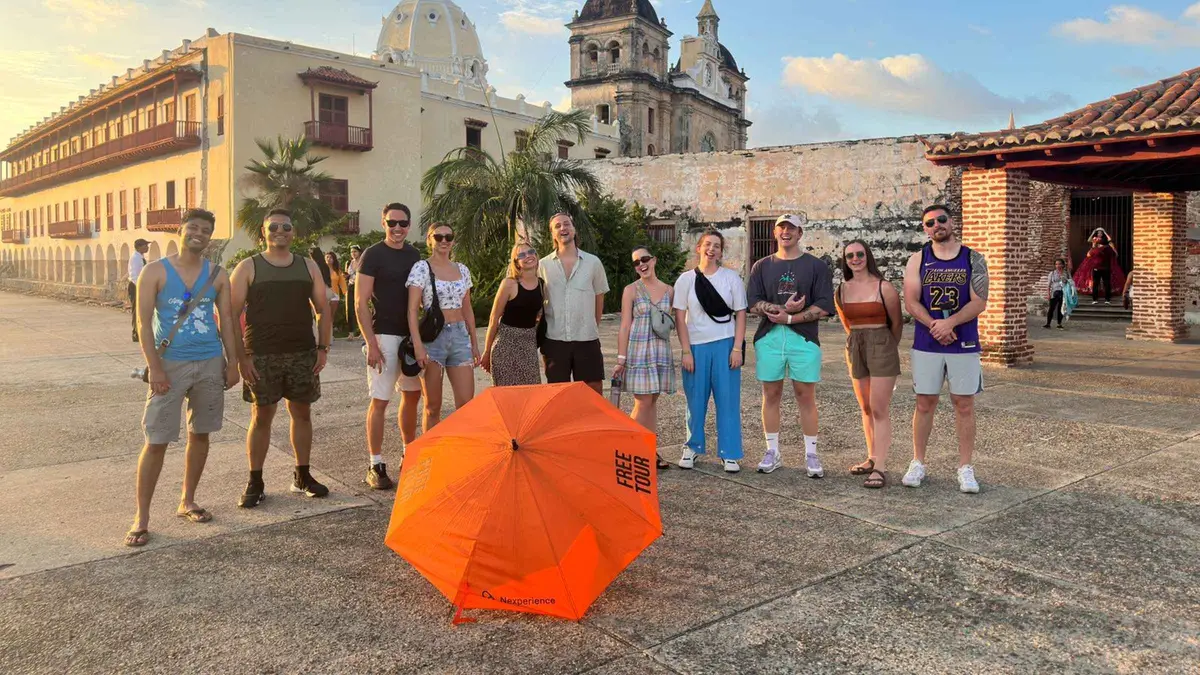
Cartagena: Historic Center and Getsemaní Shared Walking Tour
A shared 2.5-hour walk through the Walled City and into Getsemani, covering the slave-trade history, the Clock Tower and the plazas behind it. Groups can run large since it's a shared departure, and there's no seating or shade break built into the route.
Check Availability from $22.40
Cartagena: Walking Tour - 6 Language Options
The same Historic Center and Getsemani ground covered by most walking tours here, but with a live guide offered in six languages including French, German, Portuguese and Italian. It suits mixed-nationality groups, though reviewers say the content overlaps heavily with other walking tours if you've already done one.
Check AvailabilityPrices, ratings and details are the platform's own. dollar figures are the listed prices — the platform bills in your account's currency.
What's inside: Banco de la República's Zenú collection
Museo del Oro Zenú is one node in a nationwide network of gold museums run by Banco de la República, Colombia's central bank, which also funds the network's flagship Museo del Oro in Bogotá. That flagship was established on 22 December 1939 as part of the bank's mission to protect the country's archaeological patrimony, and it has grown into a collection of roughly 55,000 pieces overall, widely cited as the largest gold-artifact collection in the world, drawing around 500,000 visitors a year to the Bogotá building alone. The network built branches out from there, in Cartagena, Calima, Quimbaya, Santa Marta, Armenia and Pasto, each one focused on the pre-Columbian culture tied most closely to its own region. Every branch in the network is free, a deliberate policy rather than a promotional discount, and the Cartagena branch is built specifically around the goldwork and material culture of the Zenú, the pre-Columbian people who lived across the river deltas of what is now Colombia's Caribbean lowlands.
The collection centers on two things: the metal objects themselves, worked into the shapes of waterfowl, alligators, fish and other animals drawn from the wetland environment the Zenú lived in, and the story of how that same environment was engineered into productive farmland through a hydraulic system most visitors have never heard of before walking in.
Zenú goldwork and the drained-field system
The Zenú's characteristic metalworking technique is known as semi-filigree, cast using the lost-wax method rather than woven from actual gold thread the way true filigree is, worked in an alloy with a high proportion of gold. Zenú goldsmiths in the mountain areas around San Jacinto worked differently, using alloys with relatively more copper and then applying a chemical heating process to dissolve the copper at the surface, leaving a gold-rich skin over a less pure core, a depletion-gilding technique that tends to wear thin over time as that surface layer erodes.
The less obvious achievement, and the one the museum spends real effort explaining, is what the Zenú did with water rather than metal. Starting around 200 BCE, they built a network of drained fields across roughly 500,000 hectares of the inland river delta, channels running as long as four kilometers connected to the natural waterways, with perpendicular irrigation ditches cut alongside them. The soil dug out to form those channels was piled into long artificial terraces two to four meters high, which is where settlements and crops actually sat, above the flood line but fed by the surrounding channel network. The system ran for roughly 1,300 years, with the periodic withdrawal of water leaving behind nutrient-rich sediment that kept the terraces fertile season after season. It fell out of use after the Spanish conquest, and while nobody maintains the channels today, the pattern is still visible in the landscape from above, a piece of pre-Columbian engineering most visitors to the Caribbean coast never learn existed until they walk into this museum.
The society behind that engineering was organized into three linked provinces rather than a single kingdom. Finzenú, in the Sinú valley, was governed by a female chief named Toto at the time the Spanish arrived. Panzenú, in the San Jorge basin, focused on agriculture under a chief named Yapel, and it's the province whose land the drained-field system covers most densely, supporting an estimated 160 people per square kilometer at the culture's peak around 950 CE. Zenúfana, further south toward the Cauca and Nechí rivers, was the primary center of gold production under a chief named Nutibara. Women held real authority in Zenú society, a detail the museum ties directly to Toto's role as a chief in her own right rather than as a consort. Spanish contact was catastrophic and fast: disease and warfare decimated the population within roughly 25 years, between 1510 and 1535, and the Zenú language itself died out generations later. A Zenú identity survives today, more than 300,000 people identified as Zenú in Colombia's most recent census, but the drained-field engineering and much of the goldworking tradition this museum documents belongs to a civilization the conquest broke apart in a single generation.
How much time to give Museo del Oro Zenú
Three ways to route the visit
Banco de la República does not publish a recommended visit length for the Cartagena branch, so the routings below are our own estimates based on the size of a typical branch museum in this network.
| Routing | What it covers | What it skips | Time |
|---|---|---|---|
| Quick visit | The main goldwork cases and the hydraulics explainer | Reading every panel in full | About 20-25 minutes |
| Full visit | Every case and panel, goldwork and drained-field system together | Nothing that is open to the public | About 30-45 minutes |
| Combined with Palacio de la Inquisición | This free museum plus the paid Palacio de la Inquisición, both on the same plaza | A separate trip across town | About 90 minutes to 2 hours total |
Do
- Go Tuesday through Saturday if your schedule allows it, Sunday closes two hours earlier and the museum is shut entirely on Monday.
- Pair the visit with Palacio de la Inquisición, a one-minute walk away on the same plaza.
- Read the drained-field hydraulics panels even if goldwork is your main interest, it's the museum's more surprising story.
- Arrive right at opening on a weekday if you want the smallest crowd.
- Treat the free entry as a reason to go, not a reason to skip it, a real pre-Columbian collection costs nothing here.
Don't
- Do not show up on a Monday, the museum is closed and there is no paid fast-track since there's no ticket to buy.
- Do not expect a reservation system, there isn't one, and none is needed for a free museum of this size.
- Do not confuse this with the flagship Museo del Oro in Bogotá, this is the smaller Cartagena branch built around Zenú material specifically.
- Do not assume any GetYourGuide tour includes a guided visit inside, none itemizes this museum as a stop.
- Do not rush past the goldwork technique explanations, semi-filigree and depletion gilding are genuinely different processes worth the two extra minutes to read.
Five things most visitors do not know about Museo del Oro Zenú
- Free entry is a network-wide policy, not a Cartagena discount. Every Banco de la República gold museum branch nationwide charges nothing, a deliberate cultural-access decision by Colombia's central bank [Banco de la República / banrepcultural.org, checked 2026-09-18]. - The Zenú drained-field system covered roughly 500,000 hectares, engineered water-management infrastructure on a scale most visitors don't associate with a pre-Columbian culture [Wikipedia, Zenú, read for this guide]. - The system ran for about 1,300 years before falling out of use after the Spanish conquest, and its channel pattern is still visible in the landscape from above today [Wikipedia, Zenú]. - Mountain Zenú goldsmiths used a different technique than the lowland Zenú, applying a chemical process to concentrate gold on the surface of a copper-heavy alloy, a gilding layer that wears away over time [Wikipedia, Zenú]. - No GetYourGuide or Viator listing itemizes a visit here, despite the museum sitting on Cartagena's central plaza next to two paid attractions that do appear on tour itineraries [GetYourGuide Cartagena listings, checked 2026-09-18].
Getting to Museo del Oro Zenú
The museum sits directly on Plaza de Bolívar inside the Walled City, next door to Palacio de la Inquisición and an easy walk from San Pedro Claver and the Clock Tower. A taxi or rideshare from Bocagrande or Getsemaní drops you within a short walk of the plaza, and if you're already exploring on foot from anywhere inside the walls, Plaza de Bolívar is central enough that you'll likely pass near it regardless of your route.
There's no ticket window to navigate since entry is free, so once you're on the plaza you simply walk in during opening hours. No advance booking or online reservation system is published, none is needed for a museum of this size. Shade on the plaza itself is limited, so factor a few minutes of open sun into your walk between this stop and Palacio de la Inquisición next door, even though the distance is short.
Museo del Oro Zenú map: Plaza de Bolívar and its neighbors
The museum sits on Plaza de Bolívar next to Palacio de la Inquisición, with San Pedro Claver and Museo Naval a few minutes' walk away.
Next stop from Museo del Oro Zenú
Walk minutes are our estimates from the GPS distances between each entrance. All four sights sit inside the same stretch of the Walled City.
Palacio de la Inquisición
The Museo Histórico de Cartagena, right next door on the same plaza, paid admission.
About 85 mSan Pedro Claver
Church, cloister and museum tied to the Jesuit priest who ministered to enslaved Africans at the port.
About 160 mMuseo Naval del Caribe
A former Jesuit school building turned naval-history museum on Plaza Santa Teresa.
About 190 mCartagena Walled City
The full guide to the fortified historic center all four of these sights sit within.
You're already inside itMuseo del Oro Zenú questions
How much does the Museo del Oro Zenú cost to enter?
Nothing. Entry is free for every visitor, part of the Banco de la República's nationwide gold museum network.
What are the opening hours for Museo del Oro Zenú?
Tuesday to Saturday 9:00 a.m. to 5:00 p.m., Sunday 10:00 a.m. to 3:00 p.m., closed Monday.
What can you see at the Museo del Oro Zenú?
Pre-Columbian Zenú goldwork made with a semi-filigree, lost-wax casting technique, and exhibits on the Zenú's drained-field hydraulic system, an engineered water-management network that once covered roughly 500,000 hectares.
Do I need to book Museo del Oro Zenú in advance?
No. There's no ticket, no reservation system and no timed entry, you can walk in any time during opening hours.
How long does a visit to Museo del Oro Zenú take?
Our routing: about 20 to 25 minutes for a quick visit, or 30 to 45 minutes to read every case and panel.
Is Museo del Oro Zenú near other Cartagena attractions?
Yes. Palacio de la Inquisición is about a 1-minute walk on the same plaza, and San Pedro Claver and Museo Naval del Caribe are a few minutes further.
Does a GetYourGuide tour include Museo del Oro Zenú?
No listing itemizes a stop here specifically, since there's no ticket to bundle. General historic-center walking tours pass the plaza it sits on.
Prices, hours and terms are set by the venue or operator and confirmed at checkout.
We may earn a commission if you book through one of our links, at no extra cost to you. Full affiliate disclosure