 Cartagena City Guide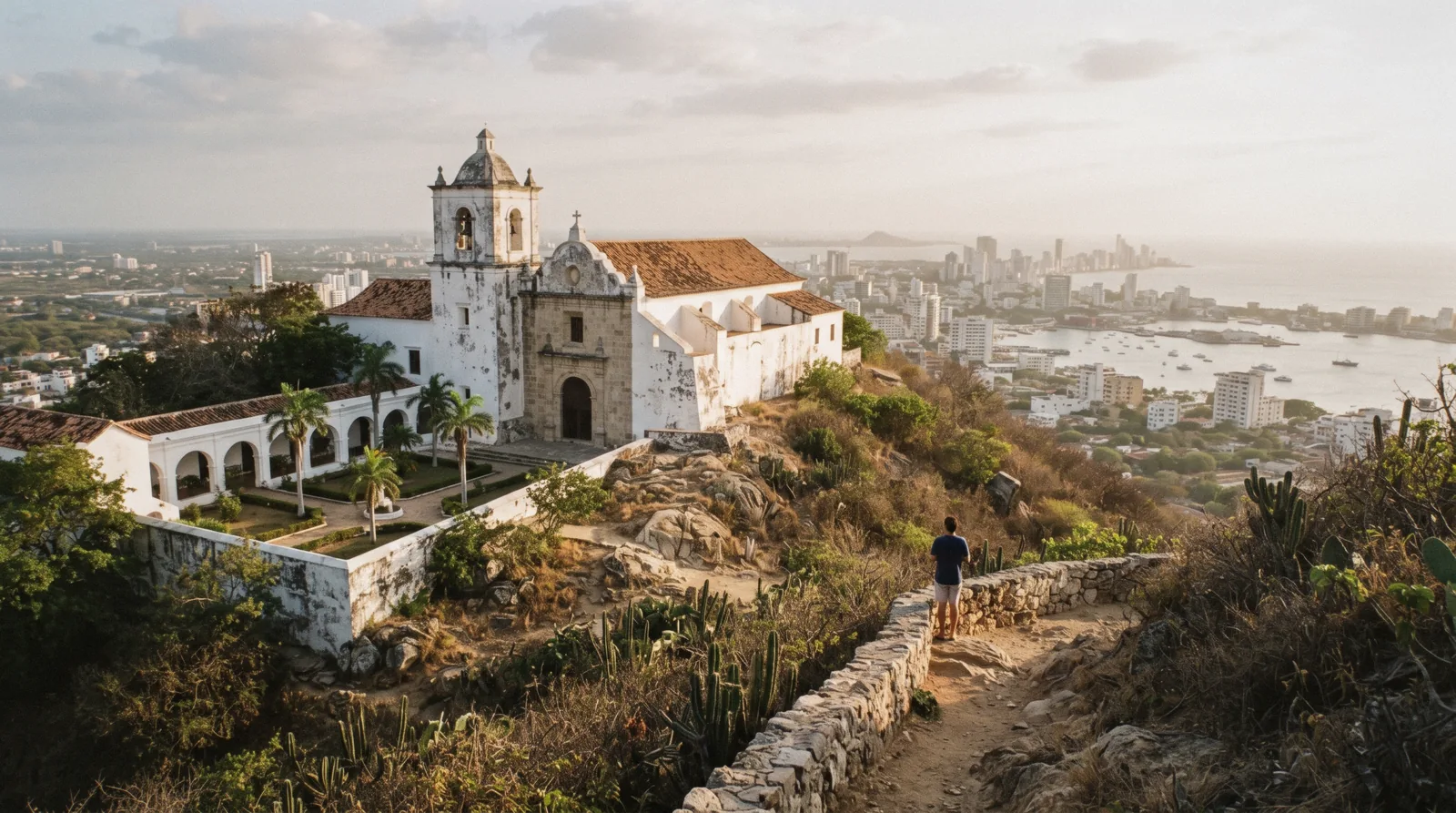
Convento y Cerro de la Popa
Convento de la Popa, Cartagena's highest hilltop landmark, is a white monastery and church reached only by taxi or tour, never on foot. This independent Cartagena travel guide covers what the official santuariolapopa.com site actually publishes, where it disagrees with the third-party listings you'll find elsewhere, and the one safety rule every local operator repeats about the approach road. There is no admission price on the official site, so this page prints none as confirmed, only the unverified figures that circulate and a clear label saying so. For the fortress on the city's other hill, see Castillo San Felipe, and for the walled city La Popa looks down on, see the walled city guide.
Quick answer Hours conflict, no published price, and why you should never go up on foot
Convento y Cerro de la Popa is open daily according to the official santuariolapopa.com site, 7:00 a.m. to 6:00 p.m., though third-party listings give 8:30 a.m. to 5:30 p.m. instead, a conflict this guide could not resolve. The official site does not publish an admission price at all, so treat the roughly $4.12 (13,000 COP) figure you'll see on travel blogs as unverified. The one fact every source agrees on: do not walk up, and do not take an unofficial moto-taxi.
Key takeaways
- The hours conflict is real and unresolved, call ahead or build in slack rather than timing a visit to the last half hour.
- A taxi that waits for you at the top, or a guided tour, is the standard advice, covered in full on the safety and scams page.
- Pair the hill with Castillo San Felipe, Cartagena's other hilltop landmark, reached the same way, by organized transport rather than on foot.
Key facts
Opening hours
| Official (santuariolapopa.com) | 7:00–18:00 |
|---|---|
| Third-party sources (Donde.co, cartagenatop.com), unverified, conflicts with official | 8:30–17:30 |
Closed None published on the official site
Admission
- Adult
- Not published by the official site
- Reduced
- Not published by the official site
- Free
- Not stated. Third-party listings (unverified) mention free entry on the last Sunday of the month, the same pattern used at other Cartagena monuments, but santuariolapopa.com does not confirm it
Planning it
- Time needed
- Not stated officially. Our routing: 30 to 45 minutes for the church, the cloister and the viewpoint, longer if a Mass is underway
- Address
- Cerro de la Popa, Cartagena de Indias
Sourced from the official santuariolapopa.com site and cross-checked against third-party listings, the only firm fact here is that no admission price is published anywhere official.
There is no ticket to compare, since the site does not sell one online and third-party price claims are not confirmed. The real decision is how you get up the hill.
| Option | Price | Includes | Cancel | Book |
|---|---|---|---|---|
| Official site, no online ticketAnyone arriving independently by taxi that waits, or as part of a private arrangement | Not published | Church, cloister and hilltop viewpoint, Mass times listed on the site | Not applicable, nothing is booked online | Official site |
Third-party listings quote roughly $4.12 (13,000 COP) adult and $3.49 (11,000 COP) child, and some mention free entry on the last Sunday of the month, the pattern used at several other Cartagena monuments. None of that is confirmed by the official site, so this page does not present it as a real price. Figures current in Q3 2026.
Getting to La Popa with a guide instead of a taxi
No operator in this guide's tour inventory currently runs a trip to Convento de la Popa itself. The card below goes to Castillo San Felipe, Cartagena's other hilltop fortress, reached the same way, by organized transport instead of on foot, and it is listed here as the closest benchmark for what a guided, transport-included visit to a Cartagena hilltop actually costs. For La Popa itself, the standard local advice is a taxi that waits for you at the top or a private driver arranged through your hotel.
 from $11.52
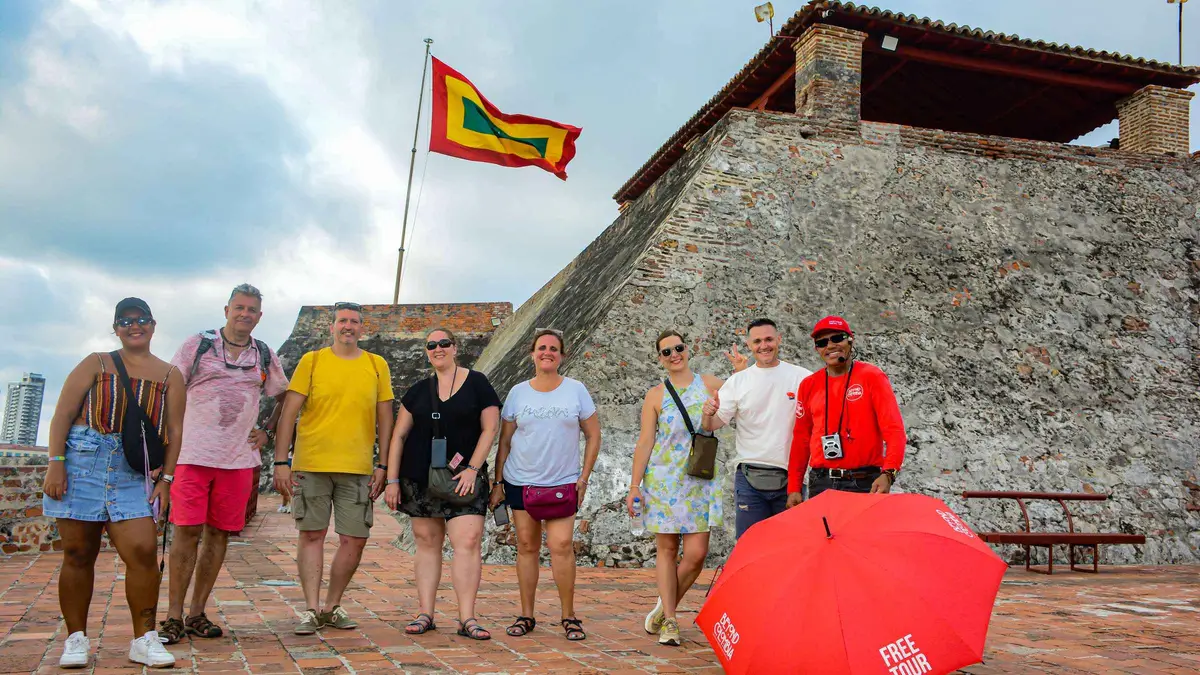
Tour Compartido al Castillo San Felipe de Barajas Cartagena
A cheaper shared alternative to the castle tour, starting in Getsemani's Plaza de la Trinidad before walking up to San Felipe de Barajas. One review describes ending up on a Spanish-only departure with no English guide present, so confirm the language before booking if that matters to you.
Check AvailabilityPrices, ratings and details are the platform's own. dollar figures are the listed prices — the platform bills in your account's currency.
History: a wooden chapel, a legend, and a cannonball near Bolívar's head
The original wooden chapel on the hill went up in 1607, built by the Discalced Augustinian friar Vicente Mallol. A year later the convent itself was raised, paid for by a wealthy Neapolitan named Fabricio Sánchez, and Fray Alonso de la Cruz Paredes became its first superior. By 1612 the building was nearly finished, about 15,000 ducats spent on it, a large sum for the period, and the whole project took roughly six or seven years [Wikipedia, Convento de la Popa].
The founding legend is the reason locals still call the cliff below the hill Salto del Cabrón. The story holds that the Virgin appeared to Fray Alonso and ordered him to build a church on the hill closest to Cartagena, where a goat-shaped evil spirit was said to be worshipped. The friar threw the goat from the top, and the name stuck [Wikipedia, Convento de la Popa].
The hill's height made it both a landmark and a target. English pirate Francis Drake attacked the city with 23 ships and 2,500 men in 1585, and the convent was hit in later raids too. Unlike the walled city below, La Popa had no fortification of its own, only its distance and elevation, which meant it survived without being destroyed but needed repeated repair [Wikipedia, Convento de la Popa].
Simón Bolívar's near miss, and the night of 11 November 1815
During the wars of independence, the convent was the site of a repelled surprise attack on the night of 11 November 1815, when troops loyal to the Spanish commander Pablo Morillo tried to retake the hill and were beaten back [Wikipedia, Convento de la Popa].
When republican troops later entered Cartagena, the Augustinian friars had already been forced out and the convent stood empty, used at times as a barracks. Simón Bolívar himself stayed there with his regiment. Tradition holds that a cannonball fired from Castillo San Felipe de Barajas, on the opposite hill, passed within centimeters of his head as he leaned out of a window on the convent's upper floor [Wikipedia, Convento de la Popa]. The friars did not return until 1961, when the convent and its hermitage were handed back to the Augustinian Recollects, who still run it today as a working religious museum alongside the cloister [Wikipedia, Convento de la Popa. Santuariolapopa.com].
What you actually see at the top
The complex is a working sanctuary, not a ruin. The official site lists a church, a cloister, and a small religious museum with items tied to the order's history in Cartagena, plus what santuariolapopa.com itself calls a 360-degree view over the city, recognizing how the whole layout of Cartagena reads from the top [santuariolapopa.com]. The Mass schedule is one of the few figures verified against the official site directly: Saturday at 7:30 a.m., and Sunday at 8:00 a.m. and 5:00 p.m.
The biggest date on the calendar is 2 February, the feast of Nuestra Señora de la Candelaria, La Popa's patron. Crowds of devotees walk up on foot from before dawn that day, the one occasion the climb is done deliberately and in numbers, a tradition unrelated to the tourist safety advice for every other day of the year [Wikipedia, Convento de la Popa]. Outside that one date, expect a quiet hilltop, the sanctuary's own devotional program, and the view, rather than a crowded attraction.
Getting there: never on foot, never an unofficial moto-taxi
La Popa is not walkable from the historic center, and this is not a matter of distance alone. The approach road has a reputation for robberies, a warning repeated consistently by tour operators rather than published by any government agency, so treat it as local operational knowledge rather than an official rule [independent operator reporting, cross-checked]. The standard advice, the same one covered in full on this guide's safety and scams page, is a taxi that waits for you at the top and brings you back down, or a guided tour that includes the hill as a stop.
An unofficial moto-taxi flagged down at the base of the hill is the option every source specifically warns against. It is cheaper and faster to arrange than a taxi that waits, and it is also the version of this trip that removes the one safeguard that matters, someone with an interest in bringing you back down safely. If your hotel or a private guide can add La Popa to a day that also covers Castillo San Felipe, that combination uses one transport booking for both hills instead of arranging the trip twice.
Convento de la Popa map: the city's other hilltop landmark
La Popa sits on its own hill east of the historic center, a separate taxi ride from Castillo San Felipe rather than a walk between the two.
Next stop from La Popa
Walk minutes are our estimates from GPS distances. Both hills near La Popa are a taxi ride, not a walk.
Castillo San Felipe de Barajas
Cartagena's other hilltop landmark, with a published admission price and official hours, unlike La Popa.
A separate taxi ride between the two hillsCartagena Walled City
The fortified historic center visible from La Popa's viewpoint, and the usual starting point for a taxi up the hill.
A taxi ride down from the hill, not walkableGetsemaní
The neighborhood just south of the walls, a practical place to base a taxi pickup for the trip up to La Popa.
A taxi ride down from the hill, not walkableConvento de la Popa questions
How much does it cost to visit Convento de la Popa?
The official santuariolapopa.com site does not publish a price at all. Third-party listings mention roughly $4.12 (13,000 COP) for adults and $3.49 (11,000 COP) for children, but this guide cannot confirm those figures against an official source, so treat them as unverified rather than a real price.
What are the opening hours for La Popa?
The official site states daily 7:00 a.m. to 6:00 p.m. Third-party sources (Donde.co, cartagenatop.com) give 8:30 a.m. to 5:30 p.m. instead, a direct conflict this guide could not resolve. Build in slack rather than arriving right before either closing time.
Is it safe to visit La Popa on your own?
Walking up is not recommended by any local operator. The approach road has a reputation for robberies, and the standard advice is a taxi that waits for you at the top or a guided tour, never an independent walk and never an unofficial moto-taxi. Full detail is on the safety and scams page.
Can I combine La Popa with Castillo San Felipe in one trip?
Both are reached only by taxi or organized transport rather than on foot, and both sit on separate hills east of the historic center. A private driver or guide can often cover both in one booking, which is more efficient than arranging two separate rides. See Castillo San Felipe for that fort's own hours and full ticket grid.
What is the Salto del Cabrón legend at La Popa?
According to the founding story, the friar Alonso de la Cruz Paredes threw a goat-shaped evil spirit from the top of the hill after the Virgin ordered him to build a church there. Cartageneros still call the cliff below the hill Salto del Cabrón, the Goat's Leap, after the legend.
What Mass times does the sanctuary keep?
The official site lists Mass on Saturday at 7:30 a.m., and Sunday at 8:00 a.m. and 5:00 p.m. These are the one set of hours verified directly against santuariolapopa.com, separate from the conflicting general visiting hours.
Prices, hours and terms are set by the venue or operator and confirmed at checkout.
We may earn a commission if you book through one of our links, at no extra cost to you. Full affiliate disclosure